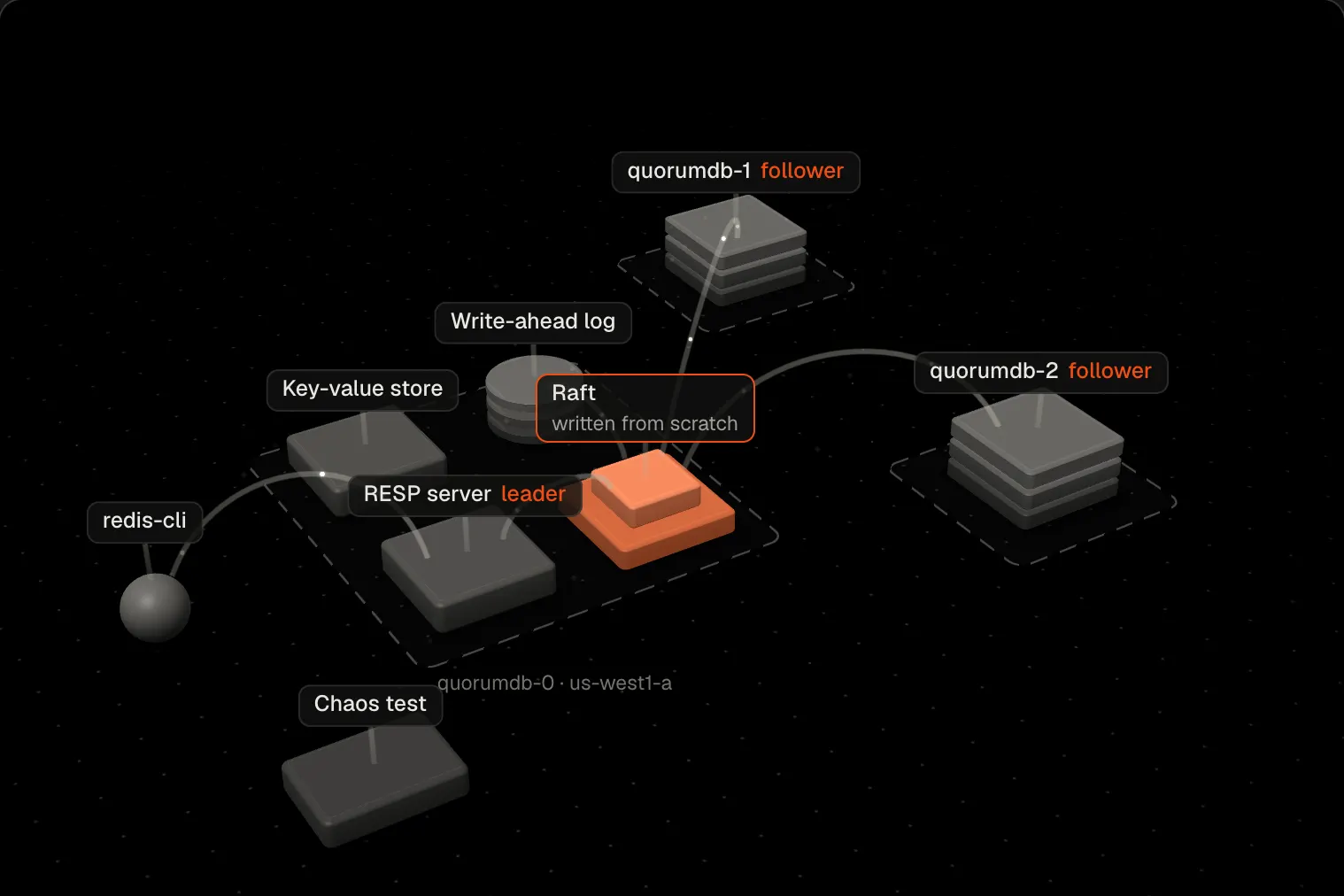
Drag to rotate · Click a block
Three replicas, one in each Google Cloud zone. The leader is shown open, with the parts inside it. Click any block to see what it does and where the code lives.
QuorumDB
A Redis-compatible key-value store in Go. Every write is replicated to three nodes with Raft, which I implemented from scratch, and the cluster runs on GKE with one node in each of three Google Cloud zones. It keeps taking writes when a node or a whole zone goes down.
Results
Confirmed writes lost
0
In 100 chaos tests with each node in a different Google Cloud zone.
Failures injected
675
Crashes, freezes and network splits across zones, all while clients kept writing.
Writes per second
38K
Across three Google Cloud zones, with automatic leader failover.
Reads per second
116K
Across zones, with no stale reads even when the leader is cut off.
Problem
A single Redis server loses data when it crashes. Copying writes to other machines only helps if the copies agree on the order of writes, a leader that gets cut off stops answering, and a crash halfway through a write can't lose anything the client was told was saved.
QuorumDB handles those cases with Raft, and a chaos test checks all of them while it injects failures.
What I built
- RESPspeaks the Redis protocol
- Routefollowers forward to the leader
- Logappend, send to both followers
- fsyncon disk before it counts
- Quorum2 of 3 saved, reply OK
- Applyupdate the key-value store
Each node runs the same Go binary and speaks RESP, so redis-cli and existing Redis clients work without changes. A client can connect to any node, and followers forward requests to the leader.
On a write, the leader appends the entry to its log and sends it to both followers while it fsyncs its own copy. It only counts its own vote after the fsync. Once two of the three nodes have the entry on disk, it commits, gets applied to the key-value store, and the client gets OK. Writes that arrive together share one round trip and one fsync.
Reads also go through the leader. Before answering, it runs a ReadIndex round, a heartbeat that confirms a majority still follows it. A leader that has been cut off can’t get that confirmation, so it can’t serve stale data.
If the followers hear nothing from the leader for about half a second, they run a pre-vote and then an election. A node that restarts loads its snapshot, replays its write-ahead log and catches up from the leader.
On Google Cloud the nodes run as a Kubernetes StatefulSet on a regional GKE cluster in us-west1, one per zone. Terraform creates everything with make up and deletes it with make down.
Design decisions
- Three zones. A quorum is two of three nodes. With only two zones, one zone would hold two nodes and losing it would lose the quorum.
- StatefulSet. A node’s data belongs to its identity, so a restarted pod needs the same name and the same persistent disk. A Deployment gives pods random names.
- No CPU limit. Kubernetes enforces CPU limits by throttling the process, which can delay heartbeats and start elections for no reason. Each node still requests 1 CPU.
- Ready means it knows the leader. A node without a leader can’t commit writes or serve linearizable reads, so Kubernetes shouldn’t send it traffic.
- Hard kills in the tests. Deleting a pod lets the process shut down cleanly and flush first. The chaos test kills the process immediately, then deletes the pod.
Testing
The chaos test crashes, freezes and partitions nodes while clients keep writing. After each test it checks that every acknowledged write is still there, runs the full history through the porcupine linearizability checker, and confirms all three nodes ended with the same data.
| Across three Google Cloud zones | Result |
|---|---|
| Chaos tests where every check passed | 100 / 100 |
| Writes that got “OK” and were then lost | 0 |
| Stale reads, even with the leader cut off | 0 |
| Crashes, freezes and network splits injected | 675 |
| Time to a new leader, typical | 817 ms |
| Time to a new leader, slowest | 2,782 ms |
| Writes per second | 38K |
| Reads per second | 116K |
To make sure the test catches real bugs, I also ran it against two builds I broke on purpose: one that replies OK before the write commits, and one that reads local state without a ReadIndex round. It caught both in 10 of 10 runs.
Known limits
- No authentication or TLS yet, so it only runs inside the cluster.
- Cluster size is fixed at startup. Scaling the StatefulSet doesn’t add members to the Raft group.
- Persistent disks are zonal, so if a zone goes down, that node waits for the zone to come back. The other two keep serving.
Run it
make cluster-up                        # start three nodes
redis-cli -p 6379 SET user:42 alice    # write to one
redis-cli -p 6381 GET user:42          # read from another: "alice"
make kill-leader                       # crash the leader; a new one takes over
make chaos # run the chaos testcluster-scheduler